When Moving Forward Means Learning to Feel
Reflections on grief, emotional masking, therapy, and the parts of ourselves we discover along the way.
Wednesday October 28, 2026
I've been doing a great deal of thinking lately about emotions. Not just the emotions we experience, but how we recognize them, how we communicate them, and sometimes how we manage to avoid them altogether.
This has been a particularly interesting subject in therapy over the past several months. I've been learning to recognize what I'm feeling without immediately judging myself for it. That might sound simple, but for someone who has spent much of her adult life focused on responsibilities, solving problems, and making sure everyone else is okay, it has been quite an adjustment.
I can usually tell you when I'm angry, sad, or frustrated. But ask me what is underneath those feelings, what brought them about, or what I actually need, and sometimes I have absolutely no idea. For years, I thought identifying the emotion was enough. I was angry. There was my answer. What more was there to understand?
Apparently, quite a lot.
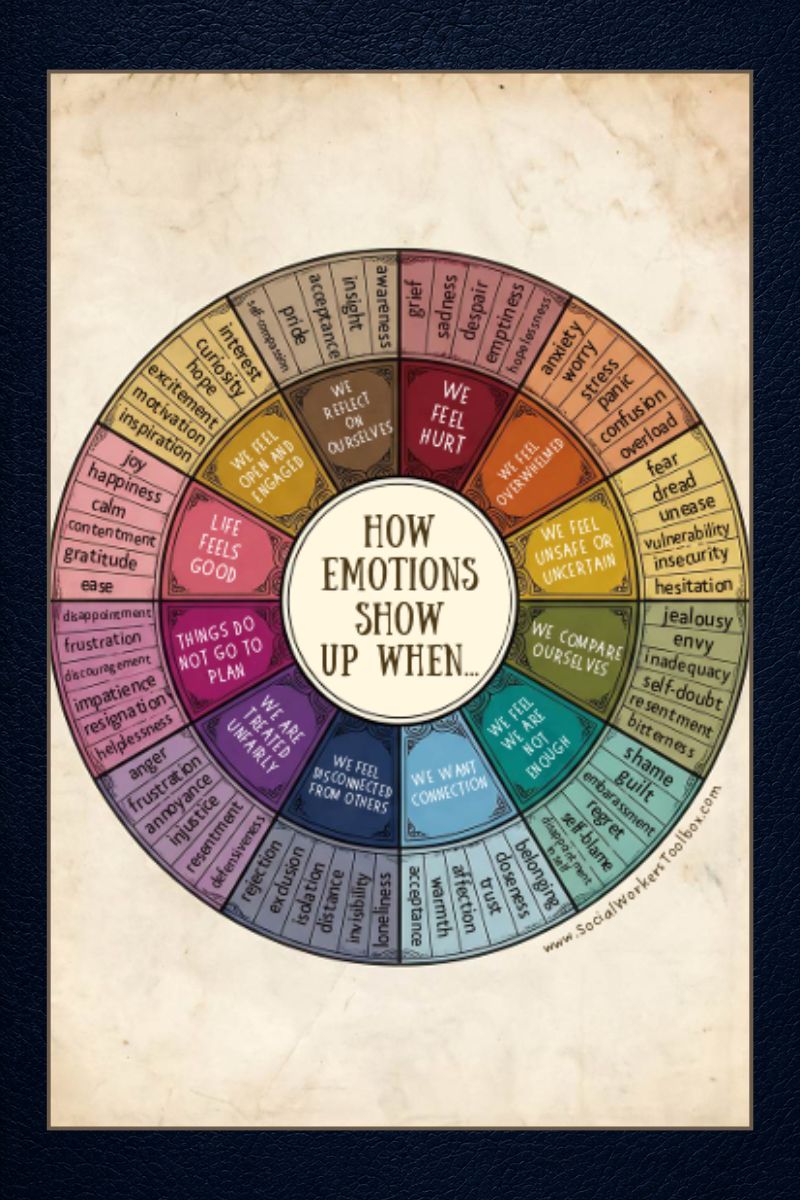
One of the tools I use regularly in therapy is something called an emotion wheel. It might seem strange that a grown woman needs a chart to help her figure out what she's feeling, but I have found it incredibly useful.
The wheel begins with basic emotions, such as anger, sadness, fear, and happiness, and then branches into more specific feelings. Sometimes I can recognize that I'm angry, but when I begin looking through the wheel, I realize that what I'm actually experiencing is disappointment, rejection, or a feeling of being dismissed.
Other times, I discover that I'm experiencing several emotions at once, and that is why finding a single word to describe what I'm feeling has been so difficult.
I have to use that wheel more often than you might imagine. And I'm learning that there is nothing wrong with needing a tool to help me understand something I spent so many years avoiding.
Finding the word gives me a place to begin. From there, I can explore why I'm feeling that way, what may have brought it about, and whether there is something I need to acknowledge or communicate. Sometimes I still don't know the answer, and I'm learning to be okay with that too.
After a recent dream, however, I'm beginning to recognize that some of this difficulty may have started much earlier in my life than I realized.
Earlier this week, after an emotionally exhausting weekend, I had a dream that stayed with me long after I woke up.
I was back in my childhood home. Everything was exactly as I remembered it. My father was sitting in his usual chair in the sunroom, and my mother was standing nearby. I even remembered her clothing, a white blouse with thin green stripes and a matching green skirt with one of those old-fashioned belts. My mother didn't wear skirts very often, which made the detail especially interesting to me.
The house, the furniture, and the familiar surroundings were so vivid. Even the cars outside belonged to another time. I was back in 1986, surrounded by the ordinary things that had once made up my everyday life.
My parents have both passed away, but there they were.
Then a question came to me. I don't remember anyone actually speaking it. It was almost as though the question simply existed in the dream.
How do you feel when people leave and never come back?
Naturally, my first instinct was to ask for clarification. What did that mean? Were we talking about someone leaving for a few days? Weeks? Months? Years?
I wanted to understand the circumstances before answering, but the length of time didn't matter. The question was about how I felt.
And I couldn't answer it.
Instead, I remember thinking that I didn't have time to consider those feelings. There were things I needed to accomplish, responsibilities that couldn't wait, and I couldn't afford to stop and think about what it meant to lose someone.
I had to keep moving forward.
Even in the dream, something about that answer bothered me. I remember walking outside, picking up my phone, and trying to arrange another appointment with my therapist because I knew there was something important I needed to understand.
The interesting thing is that I was already scheduled to see her that Thursday at 3:45. But when I called, a man answered, even though my therapist works alone, and told me the only appointment available was Thursday at 3:45.
I kept explaining that I already had that appointment. I needed another one. He couldn't offer me anything else.
I eventually got into my old white Buick Century, and that was where the dream ended.
When I woke up, I couldn't stop thinking about that question. Why was it so difficult for me to answer? Shouldn't it have been easy to know how I felt about losing someone I loved?
And the more I thought about it, the more my thoughts returned to my father.
He died when I was twenty years old. I remember how deeply I grieved his death, but what I've only recently begun to understand is that I didn't simply lose someone I loved. I lost the person who made me feel safe.
My father made me feel seen. He listened to me without requiring me to explain or defend myself. I could simply sit with him and talk, and he would listen. There was a security in his presence that I don't think I fully understood until I no longer had it.
He was my safe place, and when he died, that security disappeared with him.
I may have been twenty, but when I look back on that time, I remember feeling so much younger. I was trying to navigate a world that suddenly felt very different, without the person who had always made me feel secure. The grief was overwhelming, and I remember becoming disconnected from life in ways I didn't understand at the time. Looking back, I can recognize periods when I felt almost detached from myself and what was happening around me. I've been exploring in therapy whether dissociation was part of how I coped with that loss.
I also made decisions during those years that I would spend a great deal of my adult life questioning. One of those decisions was becoming attached to the man I would eventually marry.
He was one of the last people to meet my father before he died. I still remember that my father had joked with him, and somehow, in the midst of my grief, that brief connection became far more significant to me than I understood at the time.
Looking back, I wonder whether I had attached a sense of my father's approval to that relationship. Perhaps being with someone who had known my father, even briefly, made me feel as though I was holding on to a small part of him.
The difficult thing to acknowledge is that I recognized the differences between us. Our personalities clashed in ways that I could see and feel, and there were warning signs that we weren't particularly well suited to one another. But I ignored much of what I was recognizing because I had already formed an emotional attachment that I didn't want to lose.
People often say that love is an action, and I believe there is truth in that. I made the choice to love my husband, and I continued making that choice even when I recognized how differently we approached life. I worked to make that love a reality, despite the incompatibilities I had noticed from the beginning.
What I didn't understand then was how much my grief may have influenced that decision. I wasn't simply choosing a relationship. In some ways, I may have been trying to preserve one of the last connections I had to my father and the security I had lost when he died.
And that is a difficult realization to sit with, especially knowing how much of my adult life was shaped by that choice.
But I want to make something clear. I don't regret my marriage. It gave me two of the most wonderful women I know, my daughters, and I wouldn't trade them for anything.
What I am learning, though, is that understanding ourselves and healing old wounds sometimes requires us to acknowledge things about our past that we may not have been ready to recognize at the time. I can be grateful for the life that came from that decision while also examining the grief and fear that may have influenced it.
And one thing I knew then, just as I know now, is that I never wanted to feel that helpless again. I didn't want to experience another loss that left me questioning my judgment, my security, and my ability to trust myself.
Somewhere along the way, I think I began protecting myself by shutting down my ability to recognize and fully experience certain emotions. I don't remember consciously deciding to do this. I simply had a life to live, responsibilities to manage, and people who needed me.
So I kept going. I kept moving forward.
And I became very good at it. So good, in fact, that Keep Moving Forward became my motto in life.
What I am only beginning to recognize now is that a coping skill I developed during one of the most painful periods of my life may have gradually become a much larger part of how I responded to the world around me.
I became accustomed to focusing on everyone else's emotions. One of my very first therapists actually described me as an emotional vampire. It sounds rather terrible, doesn't it? Haha. But what she meant was that I had become so accustomed to absorbing other people's emotions that I was almost experiencing their feelings in place of my own.
If someone was struggling, I felt their distress and wanted to make it better. If they were hurting, I wanted to understand why and find a way to relieve that pain. It was almost as though I could take their emotions into myself, work through them, and help them feel better.
But while I was so occupied with everyone else's emotional experiences, something was happening to me. I was becoming increasingly withdrawn from my own feelings, disconnecting from myself, and experiencing what I now recognize as periods of dissociation.
I had become remarkably attentive to what everyone else was feeling while losing touch with what was happening within me.
And I think that may have been another way I learned to keep moving forward. As long as I was occupied with someone else's emotions, I didn't have to confront my own.
Somewhere along the way, I also lost the ability to describe what I was feeling beyond a few basic words. I was sad. I was angry. I was frustrated. Those were the words I used, and I believed they adequately described what I was experiencing.
But there wasn't much depth beyond them.
I didn't always recognize when anger was covering hurt, or when frustration had something to do with feeling dismissed. I could say I was sad without stopping to understand whether I was experiencing disappointment, loneliness, grief, or something else entirely.
Sometimes I didn't even know what I was feeling. I simply knew something was uncomfortable, and my instinct was to move past it.
I wasn't necessarily without emotion. I was disconnected from understanding it.
And I think that may be part of why a particular friendship has become so emotionally exhausting for me lately.
I care deeply about mental health. It is part of my own story, and I believe people deserve compassion when they are struggling. I also believe we have a responsibility to participate in our own well-being as much as we are able, even when our limitations make that difficult.
Those two beliefs have not always been easy for me to balance. Then again, finding balance is another one of those things I seem to struggle with regularly. Haha.
This friendship has challenged me to look more closely at some of my reactions. I've noticed that certain conversations leave me frustrated in ways I don't always understand. Rather than immediately examining the other person's behavior, I've been trying to ask myself what is actually happening within me.
One question in particular has caught my attention.
Why do I sometimes feel such a strong need to be right?
That question has been especially interesting because I'm beginning to wonder whether being right is even what I'm looking for.
There have been times when I've offered an observation or suggestion, only to feel that it wasn't really heard. Later, when something happened that seemed to confirm what I had originally said, I would find myself thinking, See? That's what I was trying to tell you.
But what was I actually looking for in those moments?
Was it really about being right? Or was I wanting someone to acknowledge that I had something worthwhile to contribute?
The more I've considered that question, the more I wonder whether some of those feelings connect to my much older need to be seen and heard.
I remember what it felt like to have my father listen to me without making me feel that I needed to justify myself. Perhaps there have been times in my adult life when I have been searching for that same experience without fully recognizing it.
That doesn't mean every disagreement is connected to my childhood or my father's death. Sometimes people simply disagree, and sometimes I am wrong. Imagine that! Haha.
But I am learning to become curious about why certain interactions affect me more strongly than others. Instead of immediately deciding what someone else has done wrong, I am trying to understand what is happening within me.
And that has been a very different experience, especially because I have spent much of my adult life being my own harshest judge and jury.
I can examine something I've said, a decision I've made, or the way I've responded to another person and find a dozen reasons why I should have handled it differently. I have a remarkable ability to put myself on trial, present the evidence, reach a verdict, and condemn myself before I've even considered offering myself a little understanding.
Perfectionism has played a significant role in this. I don't simply want to make good decisions. I want to avoid making mistakes, especially the kinds that might have painful consequences. And when I believe I've made one, I can be absolutely relentless with myself.
What I'm beginning to recognize is that I have often treated my emotions the same way.
Instead of simply acknowledging that I'm angry, I question whether I have a right to be angry. If I'm frustrated with someone who is struggling, I begin examining whether that makes me unkind or lacking in compassion. If I feel nothing when I believe I should be sad, I wonder what is wrong with me.
There is almost always a judgment attached to the feeling.
And sitting with myself, my compulsions, and my emotions can be overwhelming at times.
Sometimes I don't particularly like what I discover. Sometimes I recognize reactions or behaviors that I wish weren't part of me. And sometimes the emotions themselves feel so uncomfortable that my instinct is to do what I've always done: find something to occupy my attention, focus on someone else's problems, or simply keep moving.
But therapy has been teaching me that recognizing something about myself doesn't require me to condemn myself for it.
I can acknowledge that I reacted poorly without deciding that I am a bad person. I can recognize that I am angry without immediately deciding whether that anger is justified. I can examine a behavior I want to change without turning the entire experience into another reason to criticize myself.
And perhaps most importantly, I can experience an emotion without needing to reach a verdict about it.
That is something I am still learning.
For years, I believed that understanding myself meant examining everything I did and identifying what needed to be corrected. Now I am beginning to recognize that understanding also requires curiosity, patience, and the willingness to experience something uncomfortable without immediately trying to change it.
Interestingly enough, I have begun recognizing many of these same struggles in the characters I write.
Back in April, I wrote two blogs about grief after we lost our sweet boy, Harry, a little Manx cat.
In Some Grief Doesn't Need an Explanation, I shared what it was like watching my daughter grieve a companion who had been with her for sixteen years. I couldn't take that pain away from her. I couldn't fix it. All I could do was be there while she experienced it.
Later, in When the Whole House Mourned, I explored how differently my daughters and I experience grief. They express theirs openly, while I have always tended to grieve privately.
I even admitted that I sometimes envy their ability to release those emotions so fully.
At the time, I believed I was simply recognizing that people grieve differently. And I still believe that. But after my recent dream, I have begun wondering whether my own way of grieving was influenced by something I experienced much earlier in life.
When I wrote Saving Lady Jane, the second novel in my Vows of the Heart series, I drew a great deal of inspiration from watching my daughter grieve Harry. I was fascinated by the differences in how we experience loss, and I wanted to explore those emotions through my characters.
In my April blog, I even recognized that the grief I was writing about was my own kind of grief. I knew my stories were helping me process something personal.
What I didn't understand was how far back that connection might reach.
Now I am beginning to wonder whether Saving Lady Jane was also helping me explore the grief I experienced when I lost my father.
Gabriel Ashford loses the people who made up his entire world. He is left trying to understand how to continue living when the future he knew has disappeared.
Jane Everly has experienced losses of her own. She has learned to protect herself by becoming almost invisible, asking little of others and keeping much of herself hidden.
Their circumstances are different from mine, but I recognize pieces of myself in both of them.
Gabriel's loss of the people who gave his life meaning. Jane's instinct to protect herself by withdrawing. The difficulty of trusting that life can offer security again after experiencing something that takes it away.
I didn't consciously sit down to write my own experience of losing my father into their story. But perhaps I was exploring more of it than I realized.
I have said before that writing is cathartic for me. It allows me to examine emotions through characters and circumstances that are different from my own. I can give those characters room to struggle, to make mistakes, to grieve, and eventually to discover a way forward.
And now I am beginning to recognize that I may have been giving myself that same opportunity.
This realization has made writing Book Three, Claiming Lady Arabella, particularly interesting.
As I develop Evan and Arabella's relationship, I have been exploring emotional masking and the importance of communication. Both characters struggle with how they recognize and express their feelings. They approach their emotions differently, and both have reasons for protecting themselves the way they do.
But neither has found the right balance in how they navigate their emotions. And there's that word again, balance. Apparently, even my fictional characters are struggling with it. Haha.
In some ways, I see Evan and Arabella as two different parts of myself. One represents the emotions I tend to mask, while the other represents the part of me that wishes I could express those feelings more openly. That's part of what makes their relationship so interesting to write. They're both trying to protect themselves emotionally while learning how to let someone else understand what they're feeling. Neither can expect the other to understand what hasn't been communicated.
I've experienced both sides of that struggle. There have been times when I've reacted emotionally before understanding what I was feeling, and other times when I've shut down, kept my thoughts to myself, or convinced myself that remaining silent was easier than explaining something uncomfortable.
And as I'm writing this, I just realized something. Haha. That is exactly what frustrated so many readers about Beatrice and Nathaniel in Winning Lady Beatrice! They struggled to communicate what they were feeling, and readers wanted them to just talk to each other already. Apparently, I had written another part of myself into their relationship without even realizing it. That rather annoying habit of keeping quiet because you think you're protecting someone else, only to end up hurting yourself in the process. How very martyr-like of me. Haha.
Through therapy, I'm learning that both ways of handling my emotions have their challenges. The part of me that expresses emotions freely sometimes needs to pause and consider how those feelings are being communicated. The part that keeps everything hidden needs to learn that opening up doesn't mean losing control.
I'm also discovering that I can experience an emotion without immediately acting on it. I can be angry without needing to confront someone, feel hurt without assuming the other person intended to hurt me, and listen to someone's struggles without making myself responsible for solving them. But recognizing and managing my feelings doesn't mean I should hide them. Sometimes I need to communicate what I'm experiencing, even when doing so feels uncomfortable.
Perhaps that's what Evan and Arabella are discovering, too. They don't need to become more like one another. They need to learn from one another, just as I'm learning to understand and make room for those different parts of myself. And I suppose we won't know exactly what they've learned, or what I've learned about myself, until I finish writing their story.
That's part of what makes writing so meaningful to me. I don't always recognize which part of myself I've placed into a character until I'm well into the story. Sometimes it's a strength I've developed, a fear I'm trying to understand, or a behavior I've only recently begun recognizing. Every character seems to carry something from my own emotional journey, and I find that fascinating.
Of course, recognizing those parts of myself is one thing. Learning how to respond to what I discover is another. And that's where my faith has become especially important, because I haven't always been very forgiving of myself when I recognize something I need to change.
I believe in personal accountability. I believe in recognizing our mistakes, taking responsibility for our choices, and making an effort to do better. But I am also learning that accountability and condemnation are not the same thing.
There is a difference between recognizing something I need to change and deciding that I deserve to be punished for having struggled with it in the first place.
Recently, I found myself working through some particularly strong feelings of anger and frustration toward someone in my life. I was so frustrated that I jokingly described wanting to slap some sense into the situation. Of course, I didn't act on that impulse, but I felt absolutely horrible for even having the thought.
And naturally, being my own harshest judge and jury, I had already found myself guilty.
I brought those feelings into therapy, where I began examining the difference between experiencing an emotion and choosing how to respond to it.
Then, rather unexpectedly, I came across Psalm 3:7.
There was David, calling out to God to strike his enemies and shatter their teeth!
I couldn't help but laugh at the timing.
Here I was, condemning myself for having an angry thought about slapping some sense into someone, and there was David expressing some rather intense frustration of his own.
Now, I'm certainly not suggesting that God is going around slapping people on my behalf, or that the person I was frustrated with is my enemy. The Psalm is a prayer for God's protection and deliverance, not permission to wish harm upon someone.
But what struck me was that David didn't pretend he wasn't angry or afraid. He brought those feelings before God.
He didn't have to make his emotions sound acceptable before acknowledging them.
And perhaps that is something I have been struggling to understand.
Having an angry thought doesn't mean I have to act upon it. Recognizing frustration doesn't mean I lack compassion. And bringing those feelings into prayer or therapy doesn't make me a bad person.
I am responsible for how I choose to respond to my emotions, but I don't have to condemn myself simply for experiencing them.
For someone who has spent years putting herself on trial for nearly every uncomfortable feeling, that distinction has become incredibly important.
And as I'm writing this, I've just noticed another rather amusing contradiction. For someone who spent so many years convincing herself she didn't have time to feel, I certainly found plenty of time to condemn myself for having emotions! And when I couldn't identify what I was feeling, I sometimes condemned myself for that, too. Apparently, my inner judge and jury never took a day off. Haha.
Which brings me back to something else I've been thinking about lately.
From December 2025 through April 2026, I worked on my Keep Moving Forward devotional and worksheet series. It grew out of my own experiences, my faith, and the things I had been learning through therapy about perseverance and finding my way through an incredibly difficult season.
At the time, I believed I had a fairly good understanding of what moving forward meant to me. After all, I had spent much of my adult life doing exactly that, continuing through grief, responsibilities, and circumstances that sometimes felt overwhelming.
Now, in October, after months of continued therapy, writing, and examining my emotional responses, I find myself looking at those same words from an entirely different perspective.
I can't help but recognize the irony. I spent so many years telling myself to keep moving forward, only to discover that somewhere along the way, I had stopped allowing myself to feel what I was moving through.
But I don't believe what I wrote earlier this year was wrong. I still believe in perseverance, in finding the strength to continue through difficult seasons, and in recognizing that progress doesn't always look the way we expect.
I'm still moving forward. That hasn't changed.
But now I imagine myself wearing a belt around my waist, with little pouches attached to it. Each pouch holds a different part of me, along with the emotions, memories, and experiences connected to that part.
I'm not quite ready to open every pouch and examine everything inside. Some of those feelings are still overwhelming, and there are parts of myself I'm only beginning to discover. But at least I'm wearing the belt now instead of leaving those feelings behind or pretending they aren't there.
I'm learning to sit with them, walk with them, and find a way to live alongside them.
The road ahead is still long, and now that I'm allowing myself to experience more of what I feel, the terrain can be rather rocky at times. There are days when carrying those emotions feels uncomfortable, when I would much rather set the whole belt aside and return to the familiar habit of simply getting on with things.
But I'm learning that I don't have to understand every feeling today. I don't have to open every pouch at once, and I certainly don't have to condemn myself for what I might discover inside.
I can take my time. I can acknowledge what I'm carrying, make room for it, and continue learning as I go.
I'm still moving forward. Only now, I'm learning to bring all those parts of myself along with me.
image credits: Click here to download the PDF of Feelings Wheel in blogs image.